魂
Air France-KLM tells GT their ban on portable air conditioners as baggage at Shanghai airport 'out of operation, safety reasons'_我的网站

一 | 讯 据国家卫健委消息,国家卫生健康委、教育部、国家中医药局、国家疾控局联合印发《关于加强医院法治建设的意见》。 意见明确,健全医务人员法治素养培育机制。
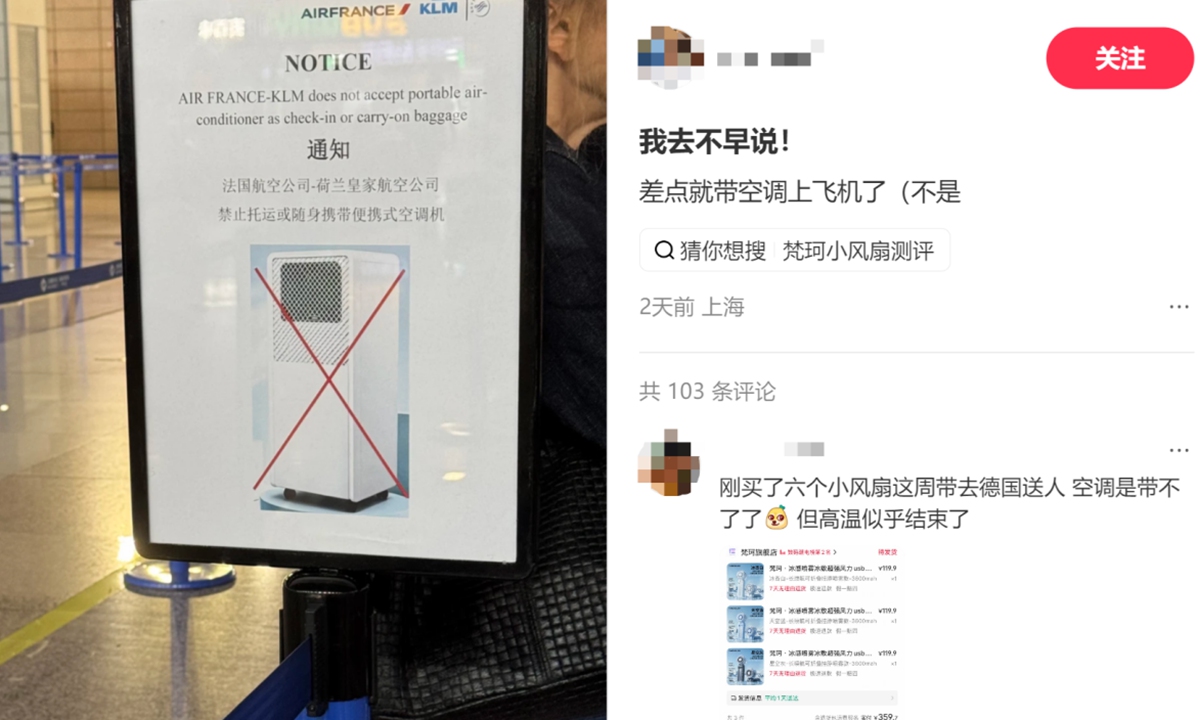
A Rednote post recently sparked discussion and jokes among netizens after showing a notice stating that "Air France-KLM does not accept portable air conditioners as checked or carry-on baggage," against the backdrop of extreme heatwaves in Europe this summer and the difficulty of securing one in European markets.
Air France-KLM customer service later confirmed to the Global Times on Monday that the restriction was in place, explaining that passengers' baggage must comply with relevant rules and requirements, which are established based on operational and safety considerations.
The discussion came as Europe has been hit by persistent extreme heat in recent months, triggered widespread heat alerts and a surge in local demand for air conditioners, a product that was not widely installed in European households.
After the RedNote post was released, some netizens shared similar experiences in the comments section, with one writing: "I just bought six small fans to take to Germany as gifts, [now that] Air conditioners are out of the question. But it seems the heatwave is finally over."
Some speculated that the sign was put up after travelers to Europe tried to imitate a widely reported case in which a Chinese employee based in Shanghai helped a French colleague visiting China on a business trip bring an air conditioner from China back to Europe by air in July.
The story was shared by the Chinese employee on RedNote. After researching different models, the Chinese selected a compact unit suitable for international transport based on its size and weight. The air conditioner reportedly used non-flammable R410A refrigerant, with a refrigerant charge of 350 grams, and contained no lithium battery. According to the post, the netizen concluded that the unit could be transported as regular baggage transport rather than being treated as dangerous goods.
The netizen also carefully consulted the ICAO technical instructions and IATA dangerous goods regulations to determine whether the air conditioner needed to be handled as dangerous goods, per the post.
The French colleague, with sufficient baggage allowance, only paid for additional packing services. The total cost came to 1,412 yuan ($209.26), including 1,260 yuan for the air conditioner, 130 yuan for airport packaging, and 22 yuan for a high-power European power adapter.
The French passenger was reportedly transported the air conditioner successfully and arrived in Barcelona.
However, airlines have reminded passengers that while some air conditioners may qualify for checked baggage, strict requirements still apply.
Battery and refrigerant restrictions must be followed, as portable air conditioners containing lithium batteries are strictly prohibited from being checked in. Meanwhile, size and weight limits must be considered as the equipment must comply with airline baggage allowances, which typically limit individual pieces to 23 kilograms or 32 kilograms, and total dimensions generally not exceeding 158 centimeters.
Professional packaging is also recommended, with travelers advised to use airport packing services to reduce the risk of damage during baggage handling.
Experts said that as Europe continues adapting to increasingly frequent heatwaves, the unusual trend of travelers carrying cooling equipment across borders highlights growing concerns over climate extremes, while also serving as a reminder that aviation safety rules remain a key consideration for transporting household appliances.
In second quarter of 2026, China-Europe freight trains have transported more than 100,000 portable air conditioners and key components, with a total cargo value of about $52 million, helping to ease supply pressures in the European market, according to a report by China Railway Group media.
。

二 | 国家卫生健康委加强统筹指导,在医学专业教材、新上岗医务人员培训、住院医师规范化培训、医学继续教育,以及医师资格考核考试、住院医师规范化培训结业考核、护士执业资格考试和卫生专业技术资格考试等事项中,增加卫生健康法律法规内容和比重,引导医务人员从业上岗首先把住“法治关”,扣好各职业阶段的第一粒“法治扣子”。围绕廉洁从业、医疗纠纷预防与处理、医疗收费、规范诊疗、健康科普、个人信息保护、数据安全等问题,开发专题式、案例式、研讨式教学培训课程,注重经常性法治教育培训,使法治宣传教育贯穿于医务人员成长全周期,融入执业全过程。 意见要求,加快医院法治专业人才培养。各地要把医院法治人才培养当作长期任务,从选拔、培养、使用和管理各环节,探索医院法治人才晋升与激励机制。

三 | 医院要结合区位特点、功能规模、质量安全等情况,明确与合规风险防控相适应的专兼职法治人员。承担医院法治建设任务的机构要全面增强履职本领,提高运用法治思维处理复杂问题的能力,为医院重要决策、重点项目、重大专项、技术创新、合规管理和医患矛盾化解提供有力法治支撑。注重完善医院法律顾问、公职律师作用发挥机制。

四 | 医联体内的医疗机构,可联合聘请法律顾问。规模较小的医疗机构,可联合购买法律服务。各省份要依托高校、研究机构、高水平医疗卫生机构、学协会等,强化医院法治专家队伍建设,发挥专家的法智治理支持优势。版权申明:凡注有“”或电头为“”的稿件,均为独家版权所有,未经许可不得转载或镜像;授权转载必须注明来源为“”,并保留“”的电头。 。

五 |
Current article:http://2evwkxv.yepenchunshouzuiwai.shop/news/20260826_8780.html
Published on:00:00:00
栏目相关
- Persona Shell:灵壳 与 Beard Papa's 开启30周年特别联动活动
- 10年未起价 刘玲玲歌台主持价飙涨
- 字母哥亲述交易心路:离开雄鹿最怕失去球迷的爱
- 9月14日0至21时 新疆新增本土无症状转确诊病例2例 本土无症状感染者21例
- 机器犬上岗 工地巡检无死角
- 【新学期报到】仓前云帆幼儿园2024学年第二学期教职工开学报到暨元宵节活动
- 巴莱巴:小时候我的偶像是博格巴 B费是顶级球星我想向他学习
- 银价暴跌,光伏狂欢?
- 这十年,奥运给伦敦留下哪些遗产
- 从东到西,从西到东,看基层挂职干部的“双向奔赴”
- 国家党支持率领先优势扩大,新政府获认可,但仍存在关键问题
- Yami Gautam Slams Rising Paid PR Culture Ahead of Dhurandhar’s Release
热门排行
- 新日“开学季”宠粉观影会:致敬同行者,一场属于追梦人的光影之约!
- 一桥连世界!全球中文爱好者在福建“顶峰相见”
- 美国把汽车关税翻倍到50%!加拿大反击:700种美国商品加税最高50%
- 〝月収200万円&タワマン生活〟から激変!39歳俳優・中村昌也〝近況報告〟ショットに「実現してるなんて凄い」「凄く雰囲気変わった」の声
- 三大存储巨头放弃自研CXL控制器
- 因凤凰北路封闭施工,济南这5条公交线路将临时调整部分运行路段
- Shah Rukh Khan Applauds Homebound for Its Honest, Moving Storytelling Before Oscars Shortlist
- 浙江省博展出《韩熙载夜宴图》,观众将可凌晨逛博物馆,文物部门人员:需提前7天预约,限时逛6分钟
- 发改委今年披露了我国重点投资“建设”的五个方面:加快5g商业用途等。
- 「いくら師匠のものとはいえ…」なぜ安青錦は“お下がりのまわし”を締めたのか? 安治川親方と“元グラドルおかみ”が招いた「タニマチ絶縁トラブル」とは
- Pak to demarche US envoy over Biden's statement on nukes: FM
- 耕地保护和质量提升法草案三审稿增加多方面规定